
Mines game competitive play guide: Competitive Strategy for 2026
Quick Summary
This Mines game competitive play guide explains how serious players approach the 5×5 casino Mines format: understand probability, choose mine counts deliberately, cash out before greed takes over, verify provably fair results, and protect your bankroll. Mines is not beatable in the sense of creating a guaranteed edge over the house, but disciplined decision-making can make your sessions more consistent and less emotional.
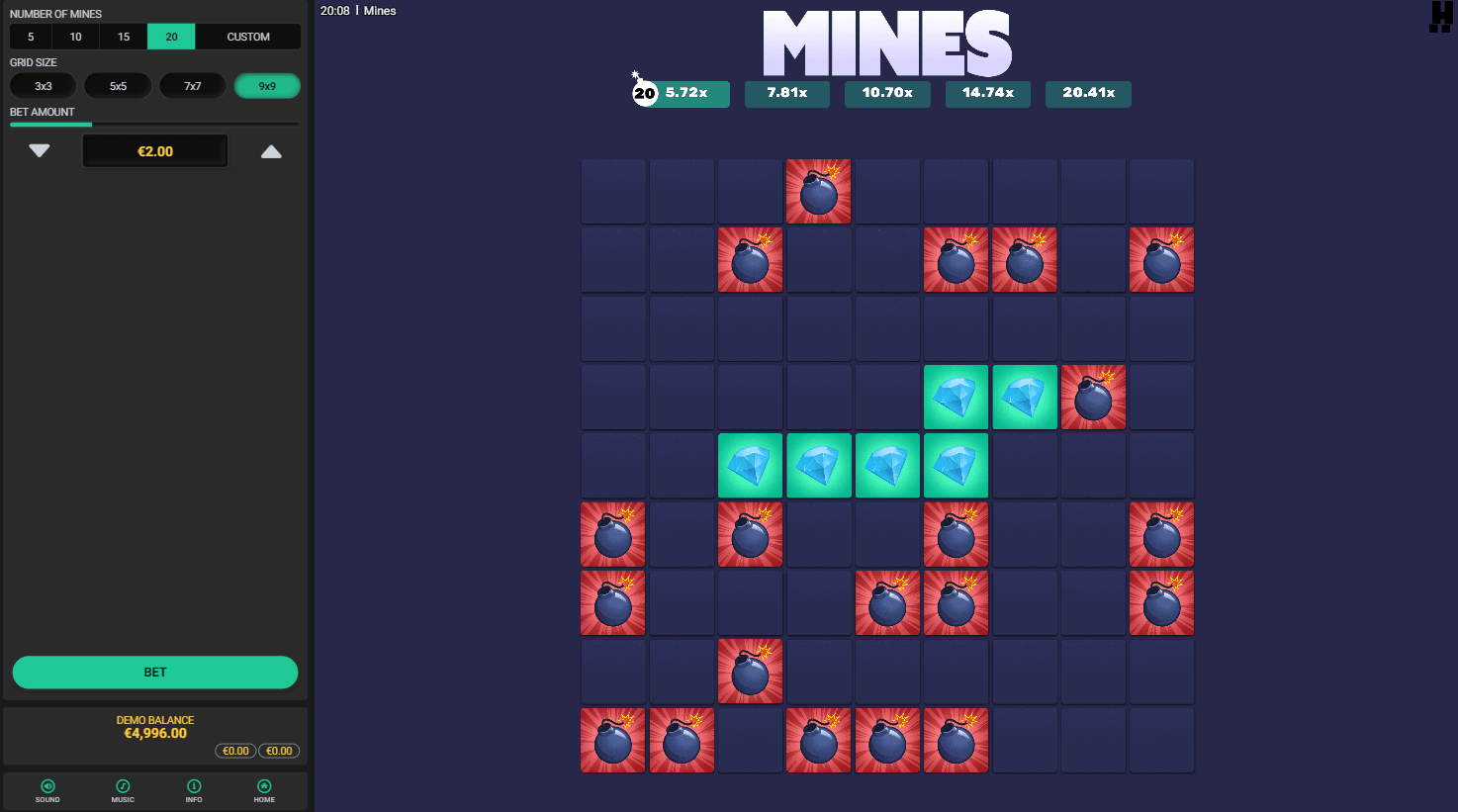
- Best for: players who enjoy active instant-win casino games with visible risk choices.
- Core skill: deciding when the reward is worth the next click.
- Key risks: chasing losses, overusing high-mine setups, and confusing random outcomes with patterns.
- Competitive focus: bankroll control, multiplier planning, RTP awareness, and mental discipline.
| Feature | Competitive Insight |
|---|---|
| Typical grid | 25 tiles arranged as a 5×5 board |
| Mine selection | Usually 1 to 24 hidden mines depending on the operator |
| Common RTP range | Often around 97% to 99%, depending on provider and rules |
| Volatility | User-defined: low mines reduce variance; high mines increase it sharply |
| Main decision | Click another tile or cash out the current multiplier |
| Fairness standard | Provably fair systems using server seed, client seed, nonce, and hashing |
| Best category fit | Casino strategy, slot guides, instant-win games, RTP and volatility education |
Overview
The purpose of this Mines game competitive play guide is to separate real strategic decisions from myths. Mines looks simple: choose a stake, choose how many mines are hidden, open safe tiles, and cash out before you reveal a mine. Yet that simplicity is exactly why competitive players study it. There are no long bonus animations, no complex paylines, and no confusing symbol tables. The game is a clean risk model where every additional click changes the relationship between probability and payout.
In 2026, Mines remains one of the most popular instant-win casino games because it gives players agency. Unlike a traditional slot spin, you are not merely waiting for reels to stop. Unlike crash games, you are not watching one shared multiplier climb. Mines asks you to make repeated decisions under pressure. That creates a competitive environment where two players facing the same RTP can experience very different results because of bet sizing, cash-out timing, and emotional control.
A strong Mines game competitive play guide must also be honest: no tile position is lucky, no diagonal pattern is superior, and no previous round can tell you where the next mine will appear when the game is properly randomized. Competitive play is not prediction. It is structured risk management. Your advantage is not over the algorithm; it is over your own worst habits.
Why Mines Feels Skill-Based
Mines is usually classified as a chance-based casino game with player-controlled decisions. The skill element comes from selection of risk level and cash-out discipline, not from identifying hidden mines. A player who chooses three mines and exits after four safe picks is playing a different volatility profile from someone who chooses fifteen mines and attempts one tile. Both may face the same house edge, but their session paths can look completely different.
This Mines game competitive play guide treats the game as a probability ladder. Each safe tile you uncover reduces the number of unknown tiles and changes the odds of surviving the next click. The multiplier rises because the risk rises. Competitive players respect that curve instead of assuming they are “due” for a safe tile.
How to Play
The basic rules are easy to learn. First, select your stake. Second, select the number of mines. Third, start the round and reveal tiles one by one. Every safe tile increases your available cash-out amount. If you reveal a mine, the round ends and the stake is lost. If you cash out before hitting a mine, you lock in the displayed payout.
For beginners using this Mines game competitive play guide, the safest learning path is to start with a low mine count in demo mode or with minimum stakes. One or two mines allow you to experience the multiplier curve without extreme variance. Once you understand how quickly the odds change, you can experiment with three to five mines for a more balanced risk-reward profile.
Step-by-Step Competitive Setup
- Set a session bankroll. Decide the maximum amount you are willing to lose before the session begins.
- Choose a unit size. Many disciplined players keep a single round between 1% and 2% of their session bankroll.
- Pick a mine count before playing. Do not change risk level impulsively after a loss.
- Define a cash-out target. For example, you may plan to take profit after three safe clicks in a low-mine setup.
- Stop after reaching limits. Use win limits and loss limits to avoid emotional decisions.
This Mines game competitive play guide recommends writing your plan before the first round. A plan made after three losses is not strategy; it is usually frustration in disguise.
Tile Selection and Pattern Myths
Many players develop favorite patterns: corners, center tiles, checkerboards, spirals, or straight lines. These patterns can help you stay consistent, but they do not improve the mathematical odds in a provably fair game. The mine placement is determined before the round is revealed, and every unrevealed tile is simply part of the same random layout.
Using a pattern can still be useful psychologically. It reduces hesitation and prevents chaotic clicking. However, this Mines game competitive play guide warns against believing that a pattern has predictive power. If you need variety to stay focused, rotate patterns only as a discipline tool, not as a superstition.
Bonus Features
Mines is not a slot in the traditional sense, but modern casino versions often include features that influence how competitive players manage sessions. Understanding these tools is essential because a feature can either support discipline or encourage overplaying.
Manual Cash Out
Manual cash out is the heart of Mines strategy. It lets you end the round when the multiplier satisfies your target. A practical Mines game competitive play guide always places cash-out discipline above maximum possible payout. The board may offer massive multipliers, but a displayed multiplier is not profit until you cash out.
Auto Cash Out and Preset Targets
Some operators provide automatic cash-out settings. For competitive players, this can be valuable because it removes hesitation. If your plan is to exit at 1.50x, auto cash out prevents you from chasing 2.00x during a lucky streak. The downside is that rigid automation can make you less attentive, so use it only when it matches a clear strategy.
Demo Mode
Demo mode is one of the most underrated learning features. It lets you test mine counts, click targets, and bankroll rules without risking money. This Mines game competitive play guide strongly recommends demo testing before changing your real-money approach. If a strategy feels stressful in demo mode, it will feel worse when actual funds are involved.
Provably Fair Verification
Crypto casinos and many instant-win platforms use provably fair systems. After a round, you can usually review the server seed, client seed, nonce, and hash information to confirm that the layout was not changed after your decisions. Verification does not make the game profitable, but it does build trust. A serious Mines game competitive play guide should encourage players to learn fairness checks rather than relying on brand claims alone.
Leaderboards, Tournaments, and Missions
Competitive Mines formats may include daily leaderboards, wager races, or missions that reward high multipliers. These can add entertainment value, but they can also distort your risk profile. If a mission pushes you into high-mine setups you would normally avoid, the reward may not justify the variance. Treat promotions as secondary value, not as a reason to abandon your bankroll plan.
RTP/Volatility
RTP, or return to player, represents the theoretical long-term payout of the game. If a Mines title advertises 98% RTP, that means the game is designed to return 98 units for every 100 wagered over a very large sample, with the remaining 2 units representing house edge. It does not mean you will receive 98% back in a short session.
This Mines game competitive play guide emphasizes that RTP and volatility are different. RTP describes long-term expected return. Volatility describes the shape of results along the way. Mines is especially interesting because the player helps choose volatility by selecting the number of hidden mines and the number of clicks before cashing out.
Low-Mine Strategy
With one or two mines, you have a higher chance of surviving each early click. The multipliers are smaller, but the round feels smoother. This style suits players who prefer longer sessions, lower variance, and controlled growth. It does not remove the house edge, and losing streaks can still happen, but it reduces the frequency of instant busts.
Balanced Three-to-Five Mine Strategy
Many competitive players favor three to five mines because the game becomes more meaningful without becoming reckless. The first few clicks offer reasonable survival chances, while the multiplier becomes attractive after several safe reveals. In this zone, the main challenge is cash-out discipline. A Mines game competitive play guide focused on sustainable play often recommends this range for intermediate players.
High-Mine Sniper Strategy
High-mine play, such as ten or more mines, creates explosive volatility. The goal is often to hit one safe tile, maybe two, and exit with a strong multiplier. This is sometimes called a sniper approach because you are not trying to clear the board; you are taking a short, high-risk shot. It can produce dramatic wins, but it can also destroy a bankroll quickly if used to chase losses.
Expected Value and the House Edge
Every round has an expected value shaped by the payout table and the probability of success. In a fair casino implementation, the multiplier is slightly lower than the true odds would require, which creates the house edge. The competitive player’s job is not to overcome that edge magically, but to choose a risk profile that matches their bankroll and avoid decisions that worsen the outcome, such as oversized bets or revenge clicking.
This Mines game competitive play guide encourages players to think in samples, not single rounds. A win does not prove a strategy is strong, and a loss does not prove it is broken. Track hundreds of rounds if you want useful data, and measure whether you followed your rules, not just whether you won.
Competitive Bankroll Strategy
Bankroll management is the difference between playing Mines competitively and simply gambling emotionally. Before you begin, divide your available funds into units. If your session bankroll is 100 units, a conservative stake might be 1 unit per round. This allows you to survive variance and evaluate your decisions over time.
A practical Mines game competitive play guide uses three limits: stake limit, loss limit, and profit limit. The stake limit controls round size. The loss limit ends a bad session before it becomes damaging. The profit limit protects a good session from turning into a break-even or losing session because of overconfidence.
Flat Betting
Flat betting means using the same stake each round. It is simple and effective for discipline. You can still change mine counts in planned blocks, but the stake remains stable. This approach makes tracking easier and reduces the temptation to double bets after losses.
Percentage Betting
Percentage betting adjusts the stake based on bankroll size. If your balance grows, your unit grows slightly; if your balance shrinks, your unit decreases. This keeps risk proportional. It is more advanced than flat betting, but it can be useful for players who record sessions carefully.
Why Martingale Systems Fail
Doubling after each loss may look logical on paper, but Mines can produce consecutive losses quickly, especially at higher mine counts. Table limits, bankroll limits, and emotional pressure make Martingale-style systems dangerous. This Mines game competitive play guide does not recommend chasing methods because they increase exposure exactly when decision quality is likely to decline.
FAQ
Q: Is this Mines game competitive play guide enough to guarantee profit?
Q: What mine count is best for competitive Mines?
Q: Do tile patterns improve my odds in Mines?
Q: How important is RTP in Mines?
Final Verdict
The best way to use this Mines game competitive play guide is to treat Mines as a controlled decision game, not a prediction puzzle. Choose your mine count intentionally, define cash-out targets, verify fairness when available, and keep stakes small enough that a losing streak cannot force bad decisions. Mines rewards clarity more than courage. The most competitive player is not the one who clicks the most tiles; it is the one who knows when the next click is no longer worth the risk.
If you play for real money, use licensed operators, confirm the rules before wagering, and never gamble with funds needed for essentials. The strongest strategy in any casino game is knowing when to stop.