
Quick Summary
Mines game professional player tips focus on three things: understanding changing probability, controlling bet size, and cashing out before emotion overrides math. In 2026, serious players treat Mines as a fast, high-RTP instant game where discipline matters more than patterns, superstition, or chasing losses.
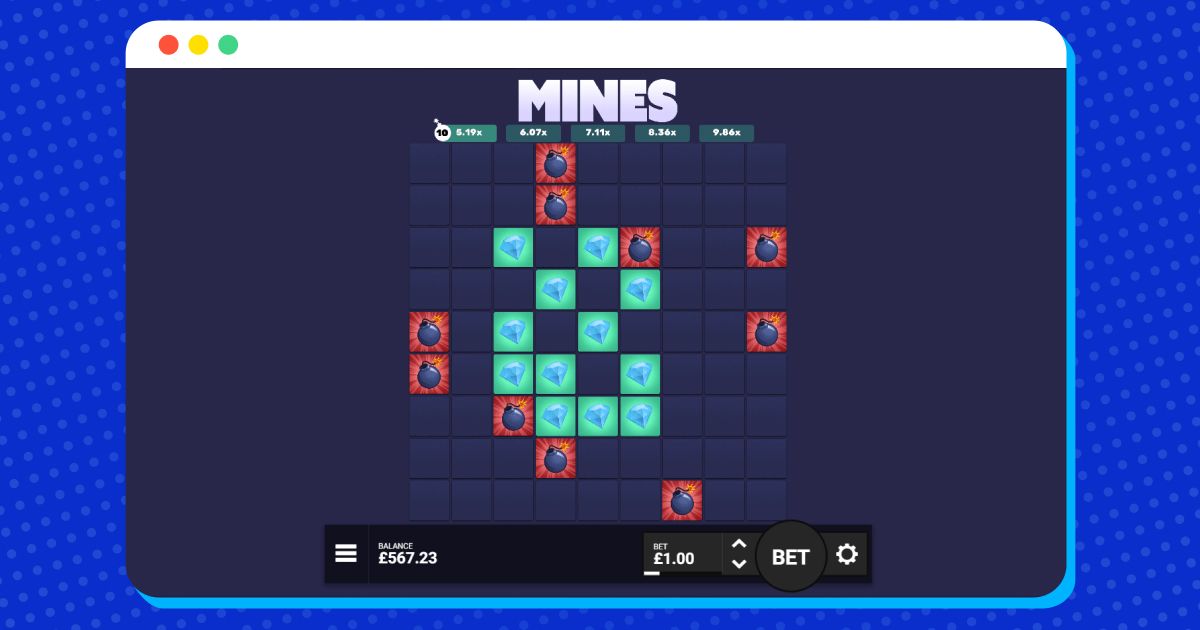
- Best professional approach: low-to-medium mine counts, fixed stake units, and pre-set cash-out targets.
- Most important skill: knowing that every extra tile increases risk even when the board looks safe.
- Core mindset: Mines is not beatable by tile patterns, but losses can be limited through bankroll structure.
- Ideal use of Mines game professional player tips: improve decision quality, not guarantee wins.
Mines game professional player tips for Smarter Play
| Key Fact | Professional Insight |
|---|---|
| Game Type | Instant win casino game with user-selected risk |
| Typical Grid | Usually 25 tiles, commonly displayed as a 5×5 board |
| Core Decision | Choose mines, reveal safe tiles, and cash out before hitting a mine |
| RTP Range | Often around 97% to 99%, depending on provider and casino settings |
| Volatility | Player-defined: fewer mines lower risk, more mines raise payout swings |
| Best Use of Strategy | Mines game professional player tips help structure bets, exits, and session limits |
Overview: Why Mines Appeals to Serious Players
Mines has become one of the most recognizable instant casino games because it is simple on the surface yet mathematically demanding underneath. The player sees a grid, chooses how many mines are hidden, then reveals tiles one by one. Each safe tile increases the multiplier, while one mine ends the round. That clean structure is exactly why Mines game professional player tips are valuable: the game gives players enough control to make decisions, but not enough control to remove chance.
Unlike slots, where the spin result is fully resolved after one click, Mines asks for repeated decisions during the same round. Should you reveal one more tile? Should you cash out at 1.50x? Should you increase the number of mines for a higher multiplier? These questions create a strategic experience, but they also create psychological traps. Professional-level play is not about predicting where mines are. It is about refusing to make low-quality decisions when adrenaline rises.
The strongest Mines game professional player tips start with a realistic premise: no pattern can change the random outcome. Corner clicking, diagonal paths, checkerboard systems, and center-first routines do not improve the actual odds. However, structured routines can still help because they reduce panic clicking and make sessions easier to review. In other words, patterns are useful for discipline, not prediction.
How to Play Mines Like a Professional
Step 1: Choose the Number of Mines
Before a round starts, you select how many mines will be hidden on the board. Fewer mines create safer, smaller multipliers. More mines produce larger potential rewards but make each tile reveal more dangerous. One of the most practical Mines game professional player tips is to avoid extremes until you fully understand how quickly risk compounds.
For example, playing with one or two mines may feel slow, but it gives you more room to practice exits and bankroll control. Playing with ten or more mines can generate exciting multipliers, yet it can also drain a balance rapidly. Experienced players often prefer a middle range because it offers meaningful payouts without turning every click into a near-all-or-nothing event.
Step 2: Set a Stake Before Emotion Enters
Professional-style Mines play begins before the first tile is clicked. Decide your unit size in advance. A common conservative rule is to risk only 1% or less of the session bankroll on a single round. If your bankroll is small, the unit should be small. If your balance grows, the unit can be recalculated only after the session ends, not during a rush of wins.
This is where Mines game professional player tips differ from casual advice. A casual player asks, “Where should I click?” A serious player asks, “How much can I lose before I must stop?” The second question matters far more because Mines is fast. Without a stake plan, even a high-RTP game can become expensive.
Step 3: Pick a Cash-Out Target
Every round should have a planned exit. Some players target 1.30x to 1.70x for lower variance. Others aim for 2.00x to 3.00x when using a moderate mine count. The exact target depends on your tolerance for risk, but the rule is the same: decide before clicking. Among all Mines game professional player tips, fixed cash-out discipline is one of the easiest to understand and hardest to maintain.
The temptation to click one more tile is the defining challenge of Mines. The multiplier rises, the board looks inviting, and the player feels momentum. But the board has no memory and no sympathy. A professional approach treats the target multiplier as a contract. Once it appears, the round is over.
Bonus Features, Auto-Play, and Modern Mines Tools
Auto-Betting Controls
Many modern Mines versions include automated settings, such as increasing or decreasing the stake after a win or loss, stopping after a profit target, or ending play after a loss limit. These tools can support Mines game professional player tips when used conservatively. They are dangerous when used as a way to chase losses automatically.
Auto-play should never replace judgment. If you use automation, set hard limits: maximum rounds, maximum loss, maximum stake, and a stop condition after a strong win. Automation is useful for consistency, but it can also make losses happen faster if the settings are aggressive.
Provably Fair Verification
Crypto-focused casinos often offer provably fair systems using server seeds, client seeds, and hashes. These tools allow players to verify that results were generated fairly and not changed after the bet. A professional player does not need to check every round manually, but understanding verification builds trust and helps separate reputable platforms from questionable ones.
One of the more advanced Mines game professional player tips is to play only where fairness information is visible, understandable, and testable. If a casino hides RTP, avoids explaining randomness, or provides unclear game rules, that is a reason to leave rather than increase your stake.
Free Demo Mode
Demo mode is not only for beginners. Serious players use free play to test mine counts, exit points, and emotional reactions without risking money. You can record how often a target multiplier appears, how often greed pushes you beyond your plan, and which setups feel too volatile. Demo results do not predict future real-money outcomes, but they help refine process.
RTP/Volatility: The Math Behind Professional Decisions
Understanding RTP
Return to Player, or RTP, describes the theoretical percentage returned to players over a very large number of rounds. Mines often offers a competitive RTP compared with many casino games, but a high RTP does not mean low risk. A player can still lose quickly by choosing too many mines, raising stakes after losses, or ignoring cash-out targets.
This is why Mines game professional player tips must combine RTP with volatility. RTP tells you the long-term pricing of the game. Volatility tells you how rough the ride can be. A game can have a strong RTP and still produce brutal short-term swings.
How Volatility Changes With Mine Count
Volatility in Mines is unusual because the player selects it. With a low mine count, many clicks are likely to be safe, but multipliers climb slowly. With a high mine count, even the first click can be dangerous, but the reward for survival is much larger. Neither setting is automatically “best.” The best setting is the one that fits your bankroll, target multiplier, and emotional control.
A core principle of Mines game professional player tips is that probability changes after every safe reveal. If there are 25 tiles and several mines hidden, each safe click reduces the number of unknown safe tiles remaining. The multiplier may look better after each reveal, but the next decision is never free. Professionals respect the rising danger instead of becoming attached to the current round.
Expected Value and the Cash-Out Mindset
Professional-minded players think in sessions, not single rounds. A single round can end immediately or produce a satisfying cash-out. Neither result proves that the strategy is good or bad. What matters is whether the player followed a repeatable framework: fixed unit, suitable mine count, defined exit, and stop-loss.
The best Mines game professional player tips do not promise to overcome the house edge. Instead, they aim to reduce avoidable mistakes. Overbetting, doubling after losses, and clicking beyond a target are not mathematical strategies; they are emotional leaks.
Advanced Bankroll Strategy for Mines
The 1% Unit Rule
The 1% rule means risking no more than 1% of your dedicated Mines bankroll on a single round. If your session bankroll is 100 units, one round equals one unit. This approach gives you enough room to survive variance and evaluate your decisions. Some cautious players use 0.5% units, especially when testing a new casino or higher mine count.
Among practical Mines game professional player tips, bankroll sizing is more important than tile selection. A player who clicks randomly with excellent bankroll control often lasts longer than a player with a beautiful pattern and reckless bet sizing.
Stop-Loss and Stop-Win Limits
A stop-loss protects the bankroll when variance turns negative. A stop-win protects profits when confidence becomes overconfidence. For example, you might end the session after losing 10 units or winning 15 units. The numbers can vary, but they must be chosen before the session starts.
Stop-win limits are underrated. Many players know when they are losing control during a downswing, but fewer recognize the danger of winning too fast. A strong win can make the next risky click feel justified. That is when disciplined Mines game professional player tips matter most.
Avoid Martingale Traps
Doubling after every loss may look logical because one win appears to recover previous losses. In Mines, this can collapse quickly. Table limits, bankroll limits, and streak variance all work against aggressive progression systems. A safer approach is flat betting or modest positive progression only after planned wins, never emotional recovery betting.
Common Mistakes Professional Players Avoid
Believing in Hot Tiles
No tile is hot, cold, lucky, or due. If the game is fair, mine placement is random according to the rules of that round. Heat maps, previous boards, or other players’ choices may be interesting, but they do not reveal your next safe tile. Reliable Mines game professional player tips always separate entertainment features from actual probability.
Playing Too Many Rounds While Tired
Mines is mentally intense because each round can involve several decisions. Fatigue leads to sloppy exits, bigger bets, and unnecessary final clicks. Short sessions are often better than marathon play. If you cannot explain why you are continuing, you should stop.
Changing Strategy After One Result
A mine on the first click does not mean the strategy failed. A big cash-out does not mean the strategy is unbeatable. Professional thinking requires a larger sample and honest tracking. Write down mine count, stake, target multiplier, result, and whether you followed your plan. Over time, your records will reveal whether your biggest problem is variance or discipline.
Mines Compared With Crash, Plinko, and Slots
Mines sits between pure instant games and more passive casino formats. Compared with Crash games, Mines offers more decisions because the player chooses both tile reveals and cash-out timing. Compared with Plinko, Mines is more active and psychologically demanding. Compared with many slots, Mines often feels cleaner because there are fewer animations, bonus teases, and near-miss effects.
That does not make Mines safer by default. The speed of play can be a hidden risk. The most effective Mines game professional player tips recognize that control is partly real and partly emotional. You control the stake, mine count, and cash-out. You do not control where the mines are.
FAQ
Q: What are the best Mines game professional player tips for beginners?
Q: Can a tile pattern improve my odds in Mines?
Q: What mine count do professional players usually prefer?
Q: Are Mines game professional player tips enough to guarantee profit?
Q: Should I use auto-play in Mines?
Final Takeaway
The professional approach to Mines is built on restraint. Choose a manageable mine count, risk a small percentage of your bankroll, decide your exit before the first click, and verify that the casino is transparent. The smartest Mines game professional player tips are not about secret tiles or magic systems. They are about making fewer emotional decisions in a game designed to test patience.
In 2026, Mines remains popular because it is fast, transparent, and easy to understand. But easy to understand does not mean easy to master. Treat every click as a priced risk, every session as a bankroll exercise, and every win as complete only when you cash out.